Jahangir Preferring a Sufi Shaikh to Kings by Brian Naraghi and Karen Morales
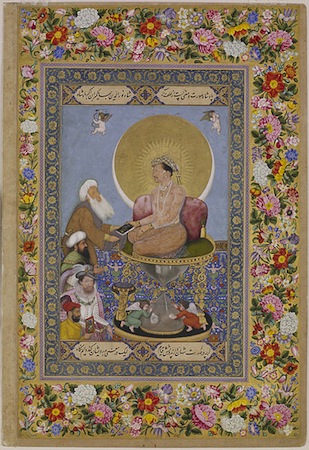
Demonstrating power in every aspect of the word, Jahangir preferring a Sufi Shaikh to Kings is a miniature painting showing Jahangir with four other individuals. This painting, which was done by Bichitr, was once a part of the Jahangirnama. It was a part of a ‘muraqqa’ (album), and would have been present with five other albums in total. However, due to the monetary value of each individual painting, they have been scattered and are no longer apart of the Jahangirnama. This painting portrays Jahangir seated with four other individuals surrounding him. It depicts Jahangir in the middle of the sun and the moon, fused together. By doing this, Jahangir symbolizes divine truth as the sun and moon are merged to look like a halo around Jahangir. “By the emperor’s own statement his new title of honor, Nur-ud-din, “light of the faith” linked him…with the sun” (Richard, 1995). Jahangir is facing four other men of different ethnicities, all in a unified line on a luxurious blue carpet. This painting was an effort by Jahangir to establish his power, through his wealth, divinity, and desirability from others.
The man closest to Jahangir is the Sufi Shaikh, who is humbly accepting his book. He is doing so in a very respectful way, as instead of using his hands to accept the gift, he is using a shawl to avoid physical contact (as physical contact with a royal individual is a cultural taboo) (Roshna 2015). “Shaikh’s decision to accept the imperial gift not directly in his hands, but in his shawl (thereby avoiding physical contact with a royal personage, a cultural taboo)”. The Sufi Shaikh is the only individual who is directly interacting with Jahangir, which shows Jahangir’s hierarchical view of each individual. The line in which all these individuals are lined in shows the hierarchical structure that the Jahangir views within each individual. Directly beneath the Sufi Shaikh, literally and hierarchically, is the Ottoman Sultan. He is dressed in gold embroidered green clothing and has a uniquely-styled turban, which displays him as a foreigner. However, he is depicted with his hands together, demonstrating his great respect towards Jahangir. Beneath the Ottoman Sultan is King James I of England. He is, like the other men, waiting to interact with Jahangir. He stands out greatly from the other individuals in this painting, due to his European attire. He is wearing a luxurious hat with a pink cloak, fitted shirt, and has exquisite jewelry on. He is the only individual gazing towards the viewer of the painting, which portrays his outside perspective with the other individuals in the room. In the bottom of the hierarchy within the painting is the artist, Bichitr. He is shown wearing a yellow robe which covers his whole body. Bichitr in this painting can be identified as Hindu, which further shows the diversity within this artwork and Islamic art in general. Bichitr was widely recognized for his formal portrait paintings, and particularly, the great details he included while painting hands. Bichitr is also painted holding a red-bordered painting which appears to be quite significant/valuable based on how present it is in this painting. He paints himself within the painting bowing between 2 horses and an elephant, and he is bowing in the direction of his Emperor as a way of showing respect and humility. Additionally, to show his respect towards the Emperor, Bichitr paints his signature on the steps that the Jahangir would have to walk on, further demonstrating his humble attitude towards the Jahangir.
As Jahangir and the Shaikh are the closest to one another, there is a clear difference between the two that becomes further noticeable, and that is the difference in wealth between the two. While Jahangir is dressed in elegant clothing and jewelry, the Shaik is dressed in very humble clothing without any form of luxury with his attire. These two show a clear distinction in monetary value, as Jahangir is dressed much more lavishly than the Sufi Shaikh. There is also tremendous respect shown by both the foreign emperor and the Shaikh. The Shaikh, as previously mentioned, refuses to use his hands to receive the present, but instead uses a shawl, and the foreign emperor is painted pressing his hands together in a respectful gesture to the Jahangir, demonstrating respect and humility towards the Jahangir. King James I in this painting is quite bizarre when analyzing it. Bichitr based his painting of King James I off of a portrait by English monarch John de Crtriz. Only one of James hands are seen in Bichitr’s painting, and it is positioned close to his weapon. However, this was common practice with European kings, so it is not appropriate to speculate that this was painted as a threat.
While there is lots to dissect on the interior of the painting, the exterior has lots to analyze and discuss as well. On the top and bottom of the painting is standard Persian writing, and the background is covered in colorful flowers. Jahangir had the opportunity to venture into his artistic interests because of the fact that his father, and previous Mughal Dynasty ruler, had already established his reign and political power in India (Lecture 10/24). Since Akbar’s was a fairly new ruler in the Indic region, he had the job of establishing his power. Because of this, the artworks that were commissioned by him were made with the intent of showing off his political power. Under his reign, there was a phenomenal amount of religious diversity and tolerance that continued into Jahangir’s reign, and can be seen in the painting itself with the presence of the Sufi Shaikh. The flowers were accurately captured Jahangir’s desire for art and nature. “Talented artists of the imperial workshops painted a wide range of subjects at Jahangir’s direction. Studies of animals, flowers, and other natural motifs were painted because of their intrinsic interest to the patron and his immediate circle (Richard 1995). The colors of the background are quite similar to the dominant colors within Jahangir’s blue carpet, which allows the viewer to understand Jahangir’s taste in reference to colors and aesthetics. However, there is also a sense of layering in this painting as there is a layer just within the outer floral layer, which is not painted in much color. This allows the outer layer to come out more and be more vibrant.
Bichitr, the creator of this artwork, was a well-respected imperial painter. He was active during the 17th century, India, under the reigns of the Mughal Emperors Jahangir, and Shah Jahan. He painted under the Mughal Dynasty Period in India. This painting is titled, “Jahangir preferring a Sufi Shaikh to Kings.” The medium is opaque watercolor, with ink and gold on paper (Smithsonian 2014). Bichitr has chosen to paint Jahangir at the focus, facing a Sufi Shaikh, near an Ottoman Sultan, King James 1 of England as well as himself (Roshna 2015). Under Jahangir’s seat reads in Persian “O Shah, may the span of your life be a thousand years” (Roshna 2015). This is written at the base of Jahangir’s throne which is painted in an hourglass to represent the passage of time, to further promote their desire for Jahangir to live a long life. However, Bichitr also included two puttis who are crying. The inclusion of these puttis is suspected to symbolize their sadness that Jahangir has limited time and that time is running out for him (hence why there is an hourglass present).
This painting is part of the Jahangirnama, that tells the autobiography of the Mughal Emperor Jahangir through a collection of artworks. This tradition of collecting memoirs in this manner reaches as far back as the reign of Babur, the first ruler of the Mughal Dynasty (Met Museum). This painting has a remarkable focus on detail, but the initial feature of limited tonal modeling eventually was replaced with more solid colors and less focus on dimension on surfaces (Seyller 2003). The style of Mughal art began under Akbar’s reign as an attempt to assert his power over the previously ununified India. This style of art can be seen as a continuation of Islamic art (lecture 10/24), that is characterized by red sandstone, use of light, and giant mausoleums. After being initiated by Akbar, Jahangir added to Mughal art under his reign, where colors became lighter and brushstrokes finer. Under Jahangir’s reign, there was visible European influence that stemmed from his fascination for art. This fascination is what led him to learn about European art and even come into contact with artists and leaders of that area.
This piece was commissioned by Jahangir to showcase his identity as a ruler through multiple means of power. The Sufi religion that is referenced by the Sufi Shaikh as a subject in this, is used to strengthen his political power since Sufism was well respected among common people because of their stress on the individual (lecture 10/22). As another subject in this painting, King James I of England also helps defined Jahangir’s identity by creating the impression of global importance. The Ottoman Sultan is also used to support Jahangir’s message of power, since he is in a respectful position toward the emperor. The various different characters in the painting bring out the theme of unity, since they are all of varying origins yet still come together to Jahangir, once again emphasizing his far spread power. Jahangir is able to portray himself as a ruler in a very divine and powerful way within the painting Jahangir preferring a Sufi Shaikh to Kings. Through the various elements that capture Jahangir’s personality in this painting, he is able to portray himself in this divine and respected manner, which he greatly desired (primarily stemming from his father and his desire for Jahangir’s success). He does this through the halo, his jewelry, clothing, puttis, and the various individuals who are before him.
word count: 1649
Sources:
- The University of Chicago. “History of Religions.” University of Chicago Press Journals, 2016, http://www.journals.uchicago.edu/doi/full/10.1086/685572?mobileUi=0&.
- Kapadia, Roshna. “Bichitr, Jahangir Preferring a Sufi Shaikh to Kings.” Khan Academy, Khan Academy, 2015, http://www.khanacademy.org/humanities/ap-art-history/south-east-se-asia/india-art/a/bichtir-jahangir-preferring-a-sufi-shaikh-to-kings.
- John, Richard. “The Mughal Empire.” ACLS Humanities E-Book – Accessoptions, 1995, quod.lib.umich.edu/cgi/t/text/pageviewer-idx?c=acls&cc=acls&idno=heb02371.0001.001&node=heb02371.0001.001%3A10&view=image&seq=117&size=100.
- Palyu, Cheryl. “Dying Inayat Khan NATURE, SPIRITUALITY, AND MORTALITY IN THE JAHANGIRNAMA.” JOURNAL OF THE LUCAS GRADUATE CONFERENCE, 2002, openaccess.leidenuniv.nl/bitstream/handle/1887/31524/JLGC%203-6%20Palyu.pdf?sequence=1.
- Goswamy, B.N. “The Spirit of Indian Painting.” Google Books, Google, 2012, books.google.com/books?hl=en&lr=&id=J5E3BQAAQBAJ&oi=fnd&pg=PT12&dq=jahangirnama%2Bpainting%2Bwith%2Bsufi%2Bshaikh&ots=_8v5NNByhb&sig=oYRCKv9b9ADF23M3RThCJPi6ga4#v=onepage&q=sufi%20shaikh&f=false.
- “Arts of the Islamic World: The Later Period.” Smarthistory, 28 Jan. 2016, smarthistory.org/arts-of-the-islamic-world-the-later-period/.
- “Jahangir Preferring a Sufi Shaikh to Kings from the St. Petersburg Album.” Smithsonian Institution, 2014, http://www.si.edu/object/fsg_F1942.15a.
- Seyller, John. “Bichitr: Grove Art.” Bichitr | Grove Art, 8 June 2003, http://www.oxfordartonline.com/groveart/view/10.1093/gao/9781884446054.001.0001/oao-9781884446054-e-7000008764#oao-9781884446054-e-7000008764.
Great description of everything 👍🏼
ReplyDeleteThe description was very detailed, nice job. Why does the turban and green clothing make him a foreigner?
ReplyDeleteOverall, a description that touches all bases and does it efficiently!
ReplyDeleteVery thorough analysis.
ReplyDeleteI feel like the writing pieces well together. I do like your thesis very much and how it was able to be expanded through the visuals and background as evidence. It would have been a little bit better (visually), if you were able to add more photos with how you stated: "The inclusion of these puttis is suspected to symbolize their sadness that Jahangir has limited time and that time is running out for him (hence why there is an hourglass present)" Overall, it is a very nice post. -Jacqueline Lai
ReplyDeleteThis comment has been removed by the author.
ReplyDeleteI like how you guys compared Jahangir and Sufi Shaikhu with the differences of their wealth and their personalities.
ReplyDeleteThis comment has been removed by the author.
ReplyDeleteI personally enjoyed reading your formal analysis as it is very informative which I find especially helpful for someone who has not seen nor heard about this painting before. Although, I enjoyed your overall post I would have wished that you added either more pictures to go with your analysis or a larger clearer picture.
ReplyDeleteThe informative paragraph regarding the author, Bichitr and the background information of where this artwork came from was very essential for the understanding of it because it gave me a much better idea of what were the influences and circumstances.
ReplyDeleteI like the way in which you touched all the different parts of contextual and formal analysis... just maybe add more pictures next time!!
ReplyDeleteYour post was very descriptive
ReplyDeleteI liked the way you described the artwork. It is very well written and informative.
ReplyDeleteGreat descriptions and analysis. Was able to get a real sense of the characters and their actions.
ReplyDeleteI like the depth that was gone in the formal analysis and historical context. It seems that the theological and cultural aspects of the piece were fully considered which was nice to see. Personally, would like more pictures, but to each their own.
ReplyDeleteVery detailed description of the artwork and historical context. well done.
ReplyDeleteYour formal analysis was very detailed and easy to understand.
ReplyDeleteYour analysis went very in depth and it was very interesting to read. I do think that it would elevate your blog post if more photos were included of your artwork and other aspects to your artwork.
ReplyDeleteMore pictures of this artwork would help people appreciate the great amount of detail put into your analysis. The analysis is very well done and it really sheds light on the figures featured here.
ReplyDeleteIt was a very nice analysis of the details of the painting and the effects that each detail has on the overall purpose of the painting.
ReplyDeleteBarin Asat
I liked how you found the translations for all of the Persian text that appeared in the painting.
ReplyDeleteGiovanny Graciano: You guys have a great description of the artwork that you present.
ReplyDeleteThe blog was really easy to read and understand. More pictures would be nice.
ReplyDeleteI liked the essay. I wouldn't necessarily say that I wish for more pictures, but maybe have the one that you use be a little clearer if possible.
ReplyDeleteVery informative.
ReplyDeleteAchyut Pachalla
ReplyDeleteThe large text makes it far easier to read.
This comment has been removed by the author.
ReplyDeleteI liked the overall format of your essay/blog post. All the sources you've cited are very rich and detailed, and I enjoy how you compared the historical context of the depicted persons. -Helen Heng
ReplyDeleteNice blog, good information and history
ReplyDelete